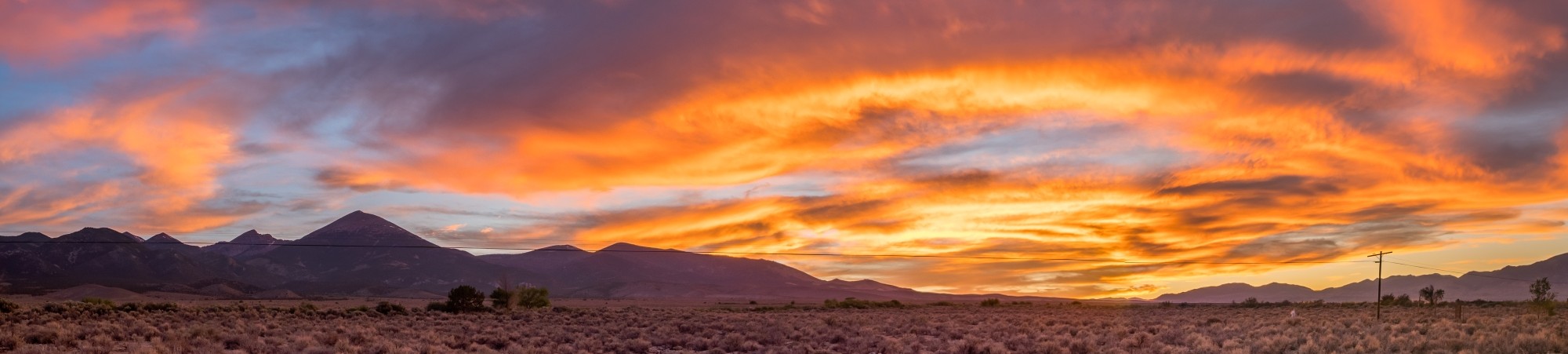
Several friends told us in no uncertain terms that a visit to Parque Nacional Iguazú (Iguazú Falls) is mandatory when in Argentina. Without a whole lot of thought or planning, we quickly booked roundtrip flights on Aerolíneas Argentinas and two nights at Hotel Saint George in Puerto Iguazú.
Next we had to figure out the park ticket situation. We plan on visiting several of Argentina’s National Parks during our trip, so it was not as simple as buying two tickets at the front gate.
Ticket options for visiting Argentina’s National Parks are: one day (with an option for a second day at half price); three-day; seven-day; or, an annual pass. A one day ticket to Iguazú Falls is $45,000 Ar; two days is $67,500 Ar (about $30 / $45 USD).
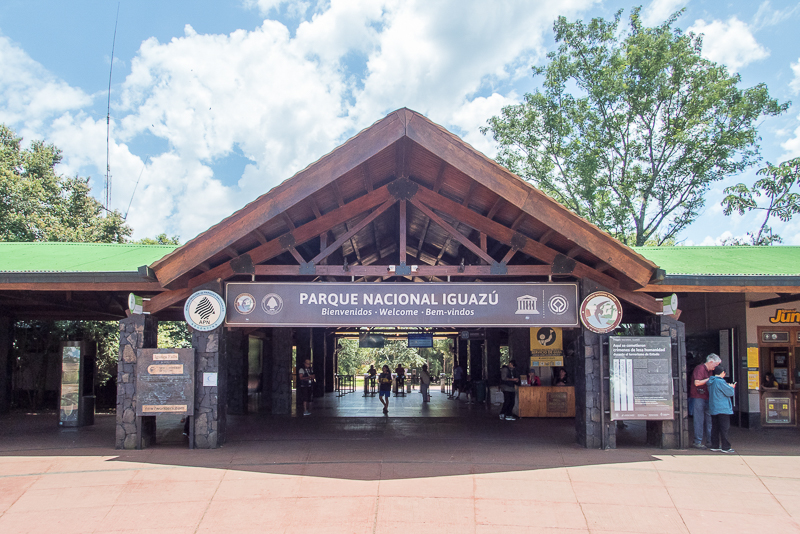
Argentina employs a tiered pricing system for provincial residents, national residents, students, and foreigners (“general” on the website). Foreign visitors pay several times more for a ticket over what a local pays.
For us, the question was whether buying an annual pass made sense. A key fact in our decision making: only an annual pass can be used at multiple parks. Three-day and seven-day tickets are park specific. In addition to Iguazú Falls, we plan to be in Parque Nacional Los Glaciers for over a week doing some sightseeing (Perito Merino Glacier in El Calafate) and hiking (around El Chaltén). A visit to Parque Nacional Nahuel Huapi (near San Carlos de Bariloche) is also possible.
Without knowing exactly how many days we will be in the parks, or even which parks, or how often the tickets are actually checked, we bought annual passes for $225,000 Ar (about $160 USD each – ouch). The passes are personal. Our names and passport numbers are on them, and you must have identification to match if asked.
Our final decision was whether to take a boat to the base of the falls. Iguazú Jungle offers a very popular boat trip for $90,000 Ar (about $65 USD each). After a decent amount of pondering we figured we might as well do it. We’ll never get a second chance. Two days before leaving Buenos Aires we booked tickets on a 10:15 AM boat ride.
With that, we were ready for our adventure.
Our 4:30 PM flight from Buenos Aires to Puerto Iguazú left from Aeroparque Internacional Jorge Newbery (AEP), rather than the main international airport, Aeropuerto Internacional Ezeiza (EZE). AEP is a much smaller airport for mostly domestic flights, along with a few international flights to neighboring countries. AEP is in town and near the Palermo neighborhood.
By the way, Aerolíneas Argentina’s economy seats are fairly comfortable and have the most legroom we have ever experienced on a plane. Certainly as much or more than any of these carriers: Delta; American; United; Air Canada; Air France; British Airways; Lufthansa; Iberia; Turkish Airlines; ITA Airways; Ryanair; Latam; Avianca; Malaysia Airlines; Air Asia; and, Vietnam Airlines. It’s hard to find words to express the joy of having legroom in the cheap seats on a plane.
Two hours after departing Buenos Aires our flight touched down in Puerto Iguazú. We walked out of the airport straight into the taxi stand, where an older gentleman was pacing up and down the sidewalk hollering “taxi” and “no Uber”.
The taxi stand quoted a flat price of $32,500 Ar (about $23 USD) for a ride to city center. As we did not book private transport our only two options were taxi or bus. The bus stop is well marked and next to the taxi stand. What is not well marked is the bus schedule or pricing.
A banner with a QR code link to Rio Uruguay, the local bus company, is prominently displayed. We clicked on the link and went to Rio Uruguay’s website. We found it to be a disaster and near unusable on the spot for quick information. After some poking around we concluded that a bus ticket was probably $10,000 Ar (about $7 USD), but the schedule was still a mystery. It was shortly before 7:00 PM. Assuming the bus ran every 30 or 60 minutes, we decided to wait a bit.
All of the other tourists jumped into taxis or arranged for private transport. The older gentleman working the taxi stand seemed perplexed that we were still standing on the sidewalk some 10 minutes later.
About then the Rio Uruguay bus arrived. We boarded, paid the driver in cash for two tickets, and settled in for the 30 minute ride to town. As this is a city route, the bus made a few stops, but not so many to meaningfully extend the ride time. Crucially we knew that the bus terminal was literally across the street from our hotel. The bus took us exactly where we wanted to go.
I was happy that we had the resolve to wait for the bus, though Stephanie was more than willing to cough up over 50% more to pay for a taxi.
Before leaving the bus terminal we confirmed that the cost of a Rio Uruguay bus ticket to go to Iguazú Falls (on the Argentina side) is $10,000 Ar per person each way. The buses run to the park every 15 to 20 minutes starting at 7:15 AM. Credit cards are accepted at the bus terminal, though you have to pay cash if buying a ticket from the driver.
Bus service to Brazil is available if you are interested in seeing the falls on the Brazil side. We skipped going to Brazil because the cost of a tourist visa, $80 per person, is prohibitively expensive for a one day trip.
During check in at Hotel Saint George, the receptionist offered to arrange transport to and from the falls for $65,000 Ar. We declined. Roundtrip bus tickets for two are only $40,000 Ar. There is no reason to pay 50% more. Private transport makes sense for three or more people, but not two.
Thinking about it, the amount we saved by riding around town on Rio Uruguay busses, instead of paying for taxis, probably paid for our meals in Puerto Iguazú.
After a short walk around town, we settled on Holy Iguazú for dinner, a brewpub with a decent selection of burgers, sandwiches, pizzas, salads, and beer. It is reasonably priced and the food was fairly decent. The only downside was that we could still hear the thumping music coming from the Patagonia Brewery across the street.
A sign at the hotel warned us that the complimentary breakfast buffet opened at 6:30 AM and would be very crowded until 8:00 AM. Not wanting to be late to the park, we chose to arrive for breakfast around 6:45 AM. It was a madhouse, full of tourists, most of whom appeared to be dressed for the Iguazú Jungle boat ride.
We walked over to the bus terminal a little before 8:00 AM, expecting a crowd based on what we had witnessed at the hotel. Nope, hardly any tourists ride the Rio Uruguay bus to Iguazú Falls. It was basically us and a few park employees. We boarded a bus to the park at about 8:15 AM, and arrived 35 minutes later.
Just outside the park entrance we stopped by the Iguazú Jungle desk, showed our voucher, and picked up our tickets for the boat ride. Because of our early arrival, we got tickets for the 9:15 AM ride instead of the 10:15 AM ride that we originally selected.
To get into the park we had to show our annual passes and passports. The whole process went smoothly. From the front gate we walked straight to the Iguazú Jungle boarding area and got in line with a couple hundred other tourists.
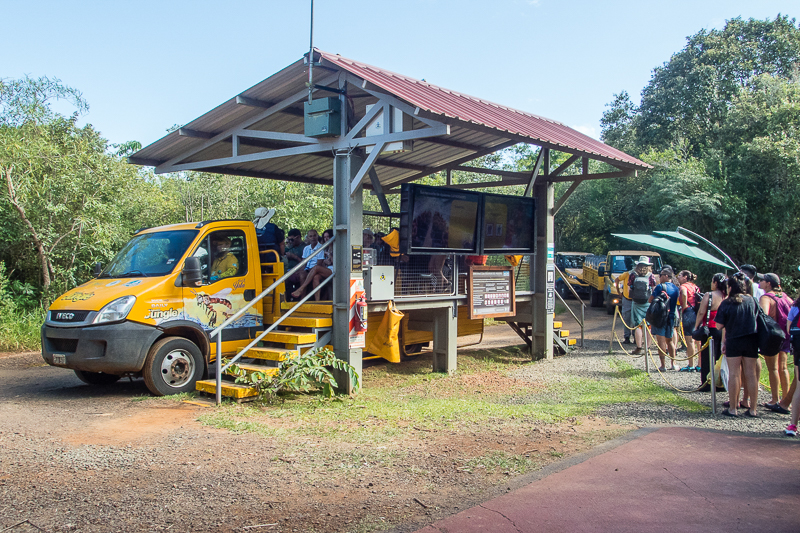
We began with a 25 minute truck ride on a dirt road through the woods, narrated by a guide in Spanish and English. At first, important park facts are recited. Parque Nacional Iguazú was created in 1934. It became a UNESCO World Heritage site in 1984. It is now one of the New Seven Wonders of the Natural World. There are 275 waterfalls in the park. Okay, that took about a minute to recite.
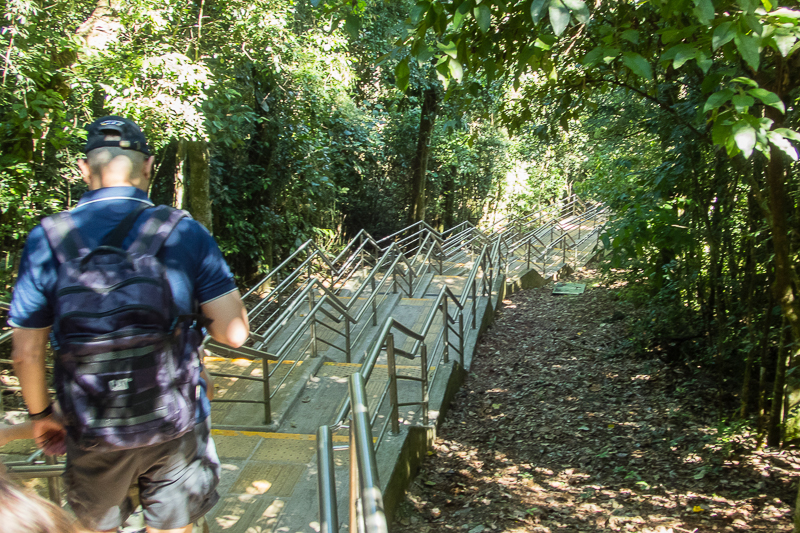
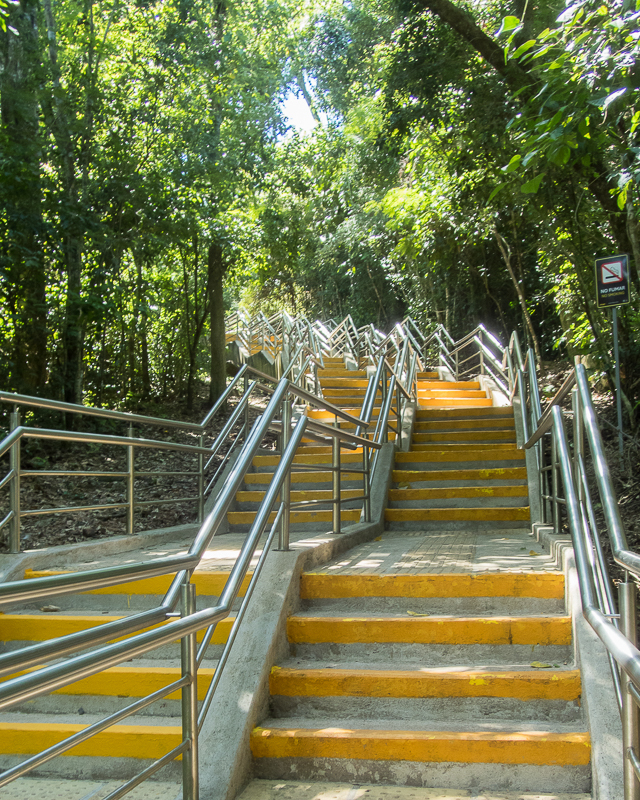
For the rest of the ride the guide had an oversized flip book with drawings of species of animals that can be found in the park, such as jaguars, tapirs, deer, pigs, birds, and so forth. Basically it was a 20 minute kindergarten class. We exited the truck at the top of a pathway that contains 300 steps down to the river’s edge. Partway down there is a bathroom, changing rooms, and a counter to pick up dry bags.
Stephanie and I were dressed for the ride and did not need to change. I had on running shorts and a dri-fit shirt. She wore a bathing suit. We picked up two dry bags, one for our day pack (with a change of clothes should we need it) and a second for our shoes and socks. The dry bags are huge. We could have easily gotten by with just one. At the dock we were fitted with a life jacket just before being ushered onto a boat. Once on board we took off our shoes and socks, tightened up our dry bags, and settled in for the ride.
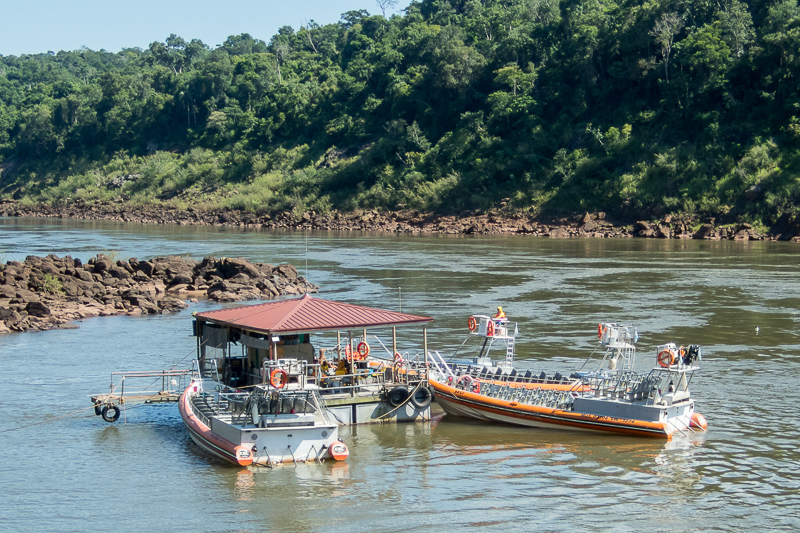
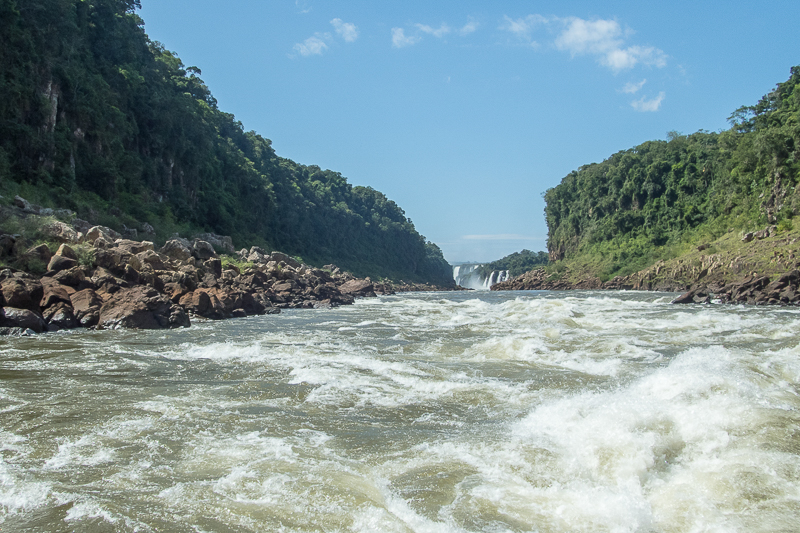
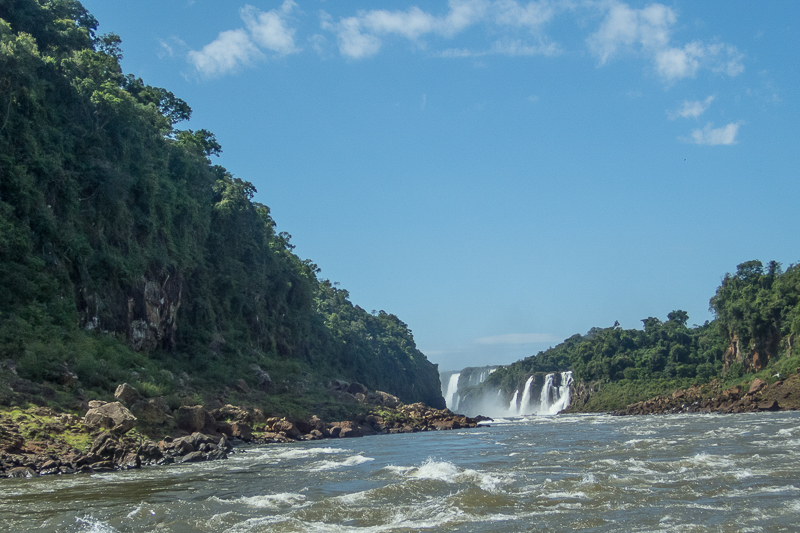
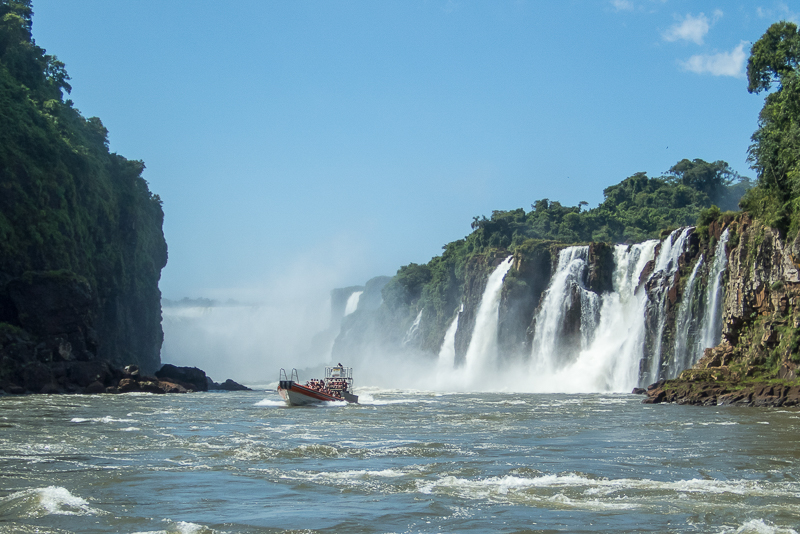
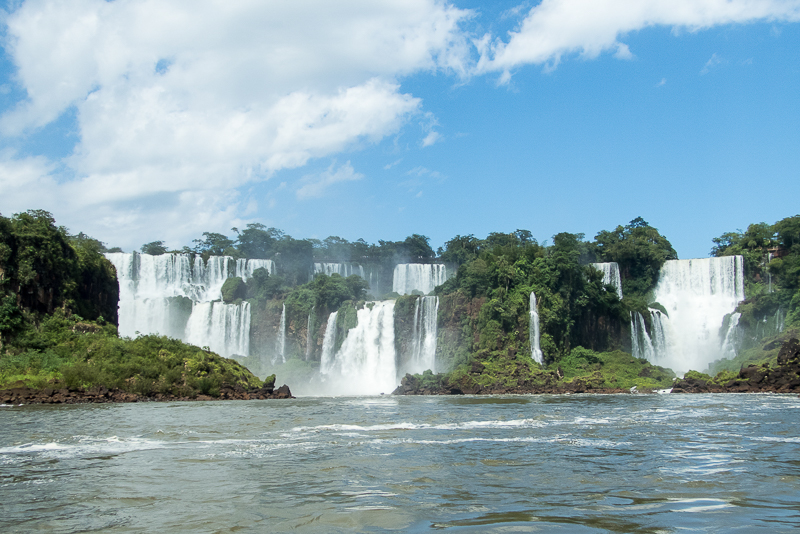
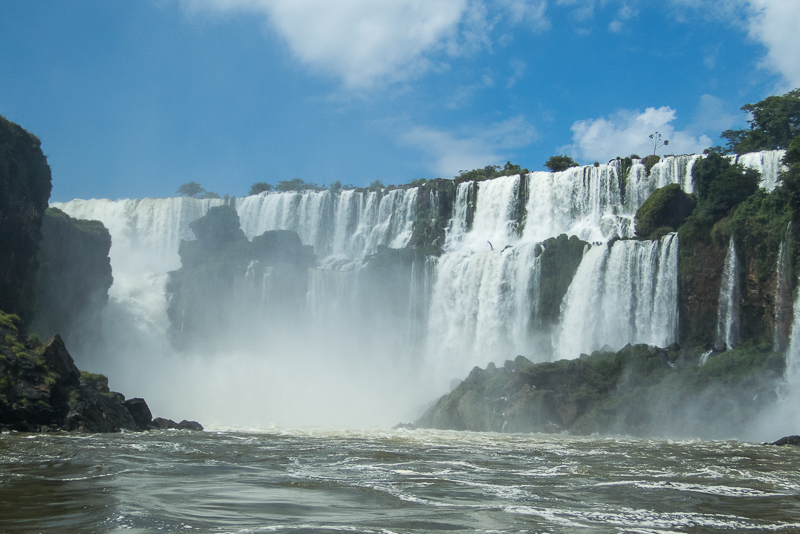
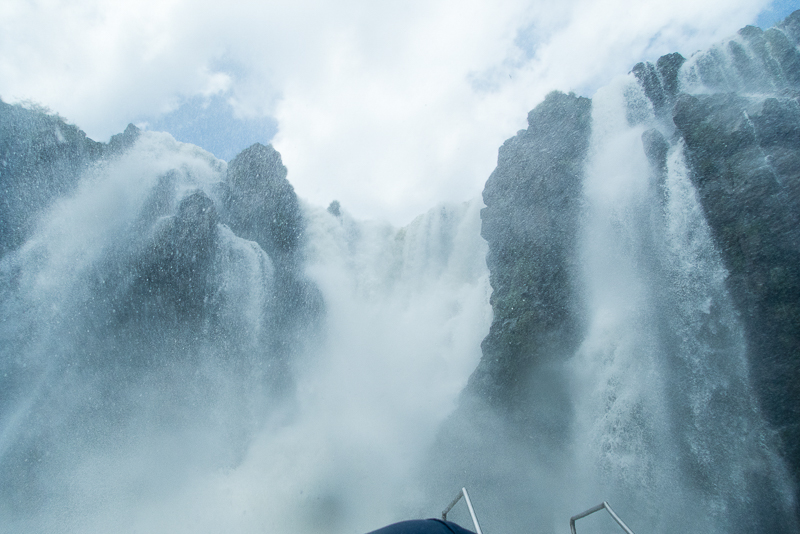
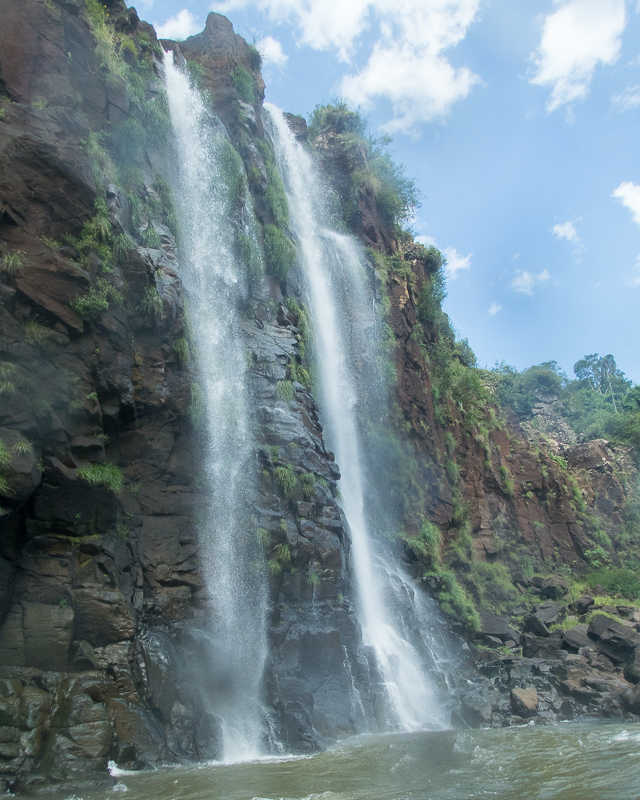
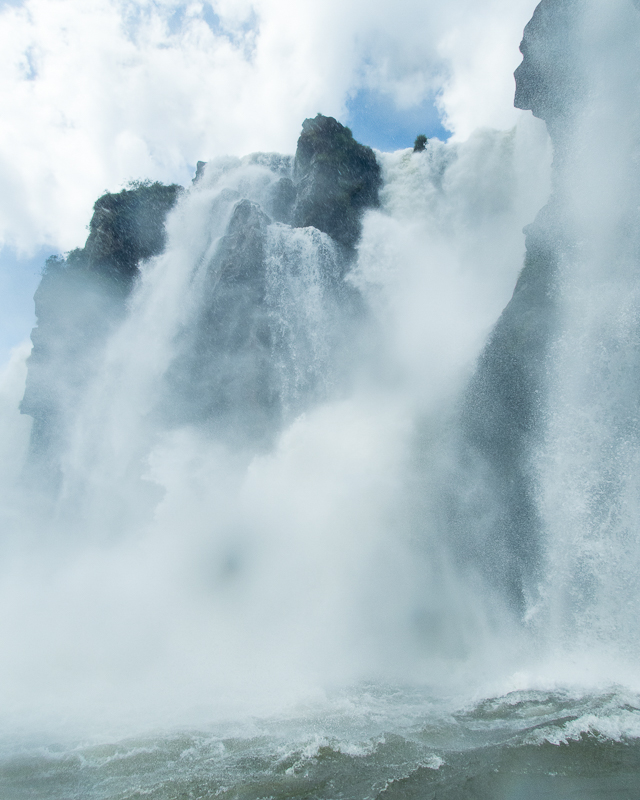
The actual boat ride lasted maybe 45 minutes. We were taken to two different sections of the falls. At each location the boat circled a time or two to give everyone good views. Then after fair warning was given the boat was driven straight into the falls a few times.
Okay, the boat did not literally go under the falls as that would have swamped it. But it sure felt like it. It’s hard to describe the sheer quantity of water coming at you from all directions. Having goggles might have been nice as keeping your eyes open is near impossible. Then again, so is breathing unless you tilt your head down. The closest analogy I can come up with is jumping into a washing machine.
If you think you can stay dry in a raincoat or pancho, good luck. We were fine with getting soaked as it was hot out.
Afterwards it was back to the boat dock, off with the life jacket, and a walk up 300 steps. Along the way we stopped at the bathroom area to put on our shoes and drop off the dry bags.
If you’re interested, you can purchase the official video of your ride (filmed by an employee on the boat) for a mere $20 or €20. We passed as we took our own video, such that it is. Looking back at the video, we really did not get that close to the actual base of the falls. But it sure felt like it.
Afterwards another truck ride brought us to the middle of the park. By then I was mostly dry, and Stephanie had changed out of her bathing suit, so we were ready to continue exploring.
Garrett and Stephanie
Read about the conclusion of our two day trip to Iguazú Falls here.
For additional posts about Argentina, or elsewhere in the world, check out our Travel Blog. It contains collected links to all of our travel posts.
Want to subscribe (or unsubscribe) for email notification of new blog posts? It is only two to three emails a month. Send your name and email address to slowtravelchronicles@gmail.com, and note subscribe (or unsubscribe) in the subject line. All email addresses will be kept confidential and not sold to any third-party. You won’t get any marketing junk or sales pitches from us.